


Page 22 - 1960 (3) Pakistan Census Of Agriculture Vol 2 West Pakistan
P. 22
xvii  _
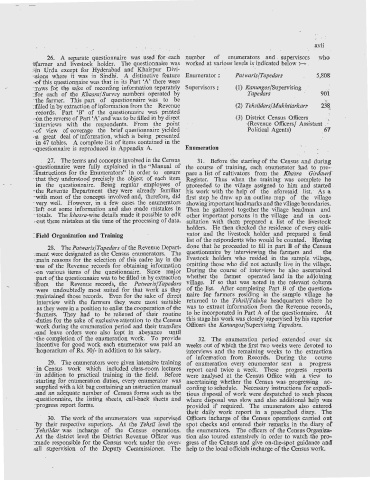
                 26.  A  separate  questionnaire  was  used  for · each  number   of   enumerators  and _ supervisors  _ who
            1/!Iarmer  and  livestock  holder.  The  questionnaire  was  worked at various levels i~"indicated below :- .
            :Jin Urdu  except  for  Hyderabad  and  Khairpur  Divi-
            -;gions  where  it  was  in- Sindhi.  A  distinctive  feature  Enumerator:   -Patwaris/Tapedars   5,808:
            ,-0f this questionnaire was that in its  Part 'A' there  were
            -Tows  for  the  sake  of  recording  information separately  Supervisors :   ( 1)  Kanwigos /Supervising
            :: for  each  of the  Khasra/ Survey  numbers  operated  by         - _ Tapedars  ·
            -ihe farmer.  This  part  of  questionnaire  was ..  to  be                                     "':.j
            ~filled in by extraction of information from the  Revenue          (2)  Tehsildars/Mukhtiarkart   238.
                                                                                                              t,
             Tecords.  Part  'B'  of  the  questionnaire  was  printed                                        )
            -on the reverse of Part 'A' and was to be filled in by direct      (3)  District  Census  Officers   . ,.
            -interviews  with  the  respondel):ts.  From  the  point              -(Revenue  Officers/  Assistant  ,-
            • - of  view  of coverage  the  brief questionnaire  yielded           Political Agents)   ·    67
            ::a  great  deal of information, which is  being  presented
             in 47 tables.  A complete list of items contained in the
            ,_~uestionn:aire-is  reproduced  in  Ap12endix  A.   Enumeration

                 27.  The terms and concepts involved in the Census   . 31.  Before  the  starting of the  Census  and  µ'udng
            ,-questionnaire  were  f  uIJy  explained  in the "Manual  of  the- course  of training,  each  enumerator  had -"to  pre- ·
            U nstructions  for  the  Enumerators"  in  order  to  ensure  pare a  list of cultivators  from  the_  Khcisra  Girdawrf
            -ihat they understood precisely the  object  of each  item  Register.  Thus  when  the  -training  was  complete  he
            · in  the  questionnaire.  Being  regular  employees  of  proceeded  to  the  village  assigned  to  him  and  startecl
            "the Revenue  Department  they were · already  familiar  his  work  with  the  help  of  the  aforesaid  list .. - As  a
            -with most  of the  concepts  involved and,  therefore,  did  first  step  he  drew  up  an outline map  of  the  village
            -very,  well.  However,  in  a  few  cases  the  enumerators  showing important landmarks and the village boundarie~.
            ~left  out  some  information  and  also  made  mistakes  in  Then  he  gathered  together the  village  headman  and
            -totals.  The khasra-wise details made it possible to edit  other  important  persons  in  the village  and  in  con-
            •out these mistakes at tlie time of the prncessing of data.  sultation  with  them  prepared  a  list  of  the  livestock
                                                               holders.  . He then checked the residence  of every culti-
            :Field  Organization  and  Training                vator  and  the  livestock  holder  and  prepared  a  final
                                                               list of the respondents who would be counted.  Having
                 28.  The Patwaris/Tapedars of the Revenue Depart-  done that he proceeded  to fill  in part B of the Census
            :1J1ent were designated as the Census  enumerators.  The   questionnaire  by  interviewing  the _farmers  ,and -  the
            "main reasons  for  the  selection  of this  cadre  lay  in the   livestock  holders  who  resided  in  the  sainple  village,,,
            -use  of the  Revenue  records  for  obtaining  information   omitting those who  did  not actually live  in the village.
            •on  various  items  of the  questionnaire.  Since  major   During  the  course · of  intervi€WS  he  also  ascertained
             part of the questionnaire was to be filled in by extraction   whether  the  farmer  operated  land  in  the  adjoining
            :;from  the  Revenµe  records,  the .  Patwaris/Tapedars   village.  If so  that  was  noted  in  the  relev1J,nt  column
            -were  undoubtedly  most  suited  for  that  work  as  they   of the  list.  After  completing  Part  B  of the question-
            :maintained those records.  Even for the sake  of  direct   naire  for  farmers  residing  in- the  sample  village  he-.-
             interview  with  the  farmers  they  were  most  suitable   returned  to  the  TehsU/fl'aluka  headquarters  where  he
            . lJ.S they were in a position to enlist the cooperation of the   was  to  extract information  from  the  Revenue  records,
            ' farmers.  They  _had  to  be  relieved  of  their  routine   to be incorporated in Part A  of the  questionnaire.  At
            -,duties for the sake  of exclusive attention to the Census   this stage his work was closely supervised. by his superior
             ·work during the enumeration period and their transfers   Officers  the  Kanungos/Supervising  Tapedars. ·
            ~-and  leave  orders  were  also  kept  in  abeyance  until
            "the completion of the enumeration  work.  To  provide   32.  The  enumeration  oeriod  extended  over  six
             incentive  for  good work  each  enumerator was paid an  weeks out of which the first two weeks were  devoted  to
            :OoQorarium of Rs. 50/- in addition to his salary.   interviews  and  the  remaining  weeks  to  the  extraction
                                                               of  information  from  Records.  Puring  the _  course
                _ 29.  The enumerators were given intensive training  of  enumeration  every  enumerator  sent  a  progress
            ' in  Census  work  which  includ·ed  class-room  lectures  report  card  twice  a  week.  These  progre~s  reports
            -'in  addition  to  practical  training  in  the  field.  Before  were  analysed  at  the  Census  Office  with  a  view  to
            tstarting for  enumeration duties,  every  enumerator  was  ascertaining  whether  the  Cen~us  was- progressing  ac-
             :supplied with a kit bii,g containing an instruction_manual  cording to schedule.  Necessary instructions for expedi-
             .and  an adequate number of  Census forms  such q.S  t:t!,e  tious disposal  of work were  despatched  to  such  place&
   r        .. questionnaire,  the  listing  sheets,  call-back  sheets  and  where  disposal  was  slow  and  also  additional help  was
            :progress report forms.                            provided  if' required. .  The  enumerators  also  entered
                                                               t_p.eir  daily  work  report  in  a- prescribed  diary.  The
                 30.  The Work  of the enumerators  was -supervised.  Officers  incharge  of the-Census  operations  carried  out
            -1:,y  their  respective  superiors.  At  the  Tehsil  level  the  spot  checks  and  entered  their  remarks  in  the  diary  of
            7ehsildar was  incharge  of  the  Census  operations.  the  enumerators.  The  officers  of the Census Organitza-
            .At  the  district  level  the  District  Revenue  Officer' was  tion also 'toured extensively in order to watch the pro-
            :made responsible for the Census work under the  over- gress  of the -Census and give  on-the.::spot  guidance  anct
            .;all  supervision  of  the  Deputy  C0mmissioner.  The  help to the local officials incharge of the Census work.

