


Page 41 - 1990(3) Cesus Of Agriculture, provience report-Punjab
P. 41
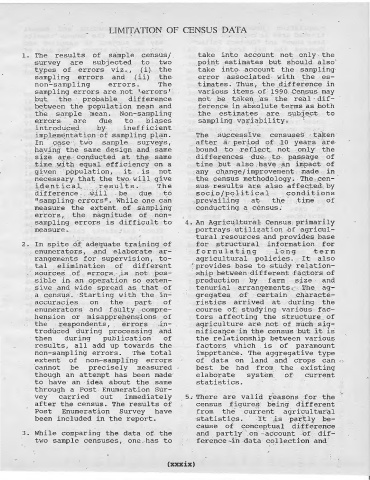
LIMITATION  OF  CENSUS  DATA


        1.  The  results  of  sample  census/ .                    take  into  account  not  only  the
            survey  are .  subjected  to  two                     point  estimates  but  should  also·
             types  of  errors  viz.,  ( i)  the                   take  into  account  the  sampling
             sampling  errors  and            (ii)  the            error  associated  with  the  es-
             non~sampling            errors.         The          timates.  Thusj  the  diffe~ence  in
             sampling  errors  are  not  •~rrors'                 various  items  of  1990  Census  may
             but  . the     probable        difference             not  be  taken  as  the  real  dif-
             between  the  population  mean  and                   ference  in absolute terms as both
             the  sample  mean.          Non-sampling              the  estimates  are  subject  to
             errors ,  are        due     to     biases            sampling  variability.            '
             introduced          by       inefficient
             implementation  of  sampling  plan.                 .The  successive  census~s  taken
             In    case    two     sample     surveys,            after  a  perioq  of  10  years  are
             having . the  same  d~sign  and  same                bound  to  reflect  not  only  the
             size  are  . conducted  at · th~  same               diff~rences  due  to  passage  of
             time  with  equal  effi6iency  on  a                 time  but  also.have  an  i~pact  of
            given  population,            it. is  not             any  change/ improvement .  made  in
             necessary  that  the  two  will  give                the  census  methodology~  The . cen-
             identical ·          results. -         The          sus  results  are  also  affected  by
            difference         will     be     due  • to          socio/political               conditions
             "sampling  errors".  While  one  can                 prevailing        at     the     time      of
            measure  the · extent  of  sampling                   conducting  a  c~nsus;
             er·rors,  the  magnitude  of  . non-
             sampling  errors  is  difficult  to              4.  An  Agrictiltural  Census  primarily
            measure.                                              portrays  utilization .of  :agricul-: .
                                                                  tural resources  and  provides  base
        2.  In  spite  of  adequate  training  of                 for  structural  information  for
           _, enumerators,  and  elaborate  ar--'                 formulating               long         term
             rangements  for  supervision,  to-                   agricultural  policies.  It  also
             tal  elimination  of            different          ~provides  base  to  st~dy  relation-
             sources  of  errors ..  is  not  pos-                ship  between different factors  of
             sible  in  an  operation  so  exten-                 production       by     fQrm    size  and
             sive  and  wide  spread  as  that  of                tenurial  arrangements.  The  ag-
             a  census.  Starting  with  the  in-                 gregates  · of  certain ' _ cparacte-
             accuracies        on    the      part     of         ristics  arrived  at  during  the
             enumerators  and  f ci.ul ty  compre-                course  of  stud~ing  various  fac-
            hension  or  misapprehensions  of                     tors  affecting · the  structure  of
             the    respondents,         errors       in-         agriculture  are  not  of  much  sig-
             troduced  during  processing  and                    nificance  in  the  census  but  it is
             then     during       publication         of         the  reiationship  between  various
             results,  all  add  up  towards  the                 factors  which  . is  of  paramount
             non-sampling  errors.           The  total           impprtanbe.  The  aggregative  type
             extent  of  non~sampling  errors                     of  data  on  land  and  crops  can  , .
            ~arinot     be    precisely  measured                 best  be  had  from  the ·  existing
             though  an  attempt  has  been  made                 elaborate        system      of     current
             to  have  an  idea  about  the  .same                statistics.
             through  a  Po~t  Enumeration  Stir-
            Vey     carried       out     immediately         5. There  are  valid  reasons  for  the
             after  the  census.  The  results  of                census  figures  being  d'ifferent
             Post    Enumera.tion  Survey  have                   from  the  · current  agricultural
             been  included  in  the  report.                     ·statistics.        lt  is  ·part;.ly  be-
                                                                  cause  of  conceptual  difference
        3.  While  comparing  the  data  of  the                  and  partly  .on  • account  of  dif-
             two  sample  censuses, .  one - has  to              ference -in •data · collection  and ·


                                                        (xxxix)

                                                                                                                           I

